In today’s complex world, the ability to think critically is more valuable than ever. This guide provides practical exercises to hone your analytical skills, enabling you to navigate information effectively and make sound judgments. We’ll explore common cognitive biases that cloud our thinking, and learn techniques to overcome them. By mastering effective questioning and analytical methods, you’ll significantly enhance your capacity for sharper, more insightful analysis.
From understanding the pitfalls of confirmation bias to mastering the art of formulating probing questions, this guide offers a structured approach to improving your critical thinking. We’ll delve into the nuances of deductive and inductive reasoning, providing real-world examples to solidify your understanding. Ultimately, this journey will empower you to become a more discerning and effective thinker.
Understanding Cognitive Biases
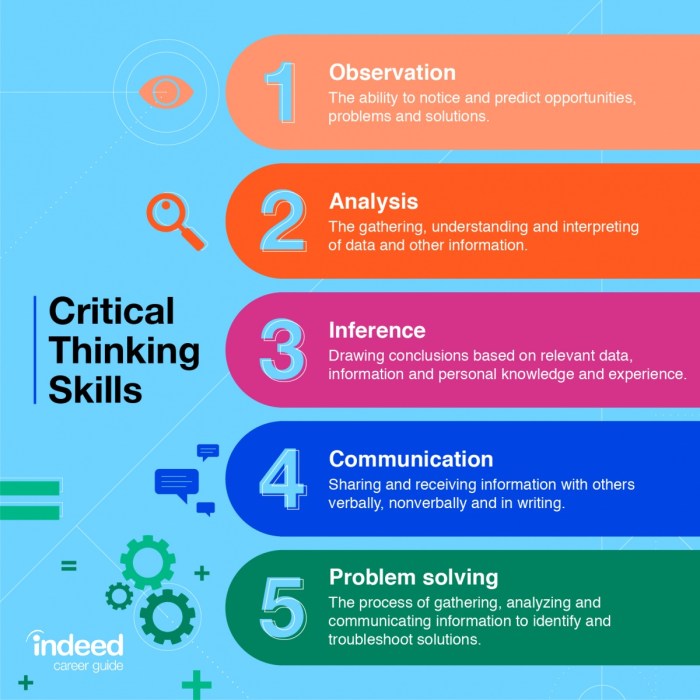
Cognitive biases are systematic patterns of deviation from norm or rationality in judgment. They are mental shortcuts our brains use to process information quickly, but these shortcuts can lead to errors in reasoning and hinder our ability to think critically. Understanding these biases is crucial for improving our analytical skills and making more informed decisions.
Three Common Cognitive Biases and Their Impact on Critical Thinking
Three prevalent cognitive biases significantly impede critical thinking: confirmation bias, anchoring bias, and the availability heuristic. Confirmation bias involves favoring information that confirms pre-existing beliefs while ignoring contradictory evidence. Anchoring bias refers to the tendency to rely too heavily on the first piece of information offered (the “anchor”) when making decisions. The availability heuristic is the tendency to overestimate the likelihood of events that are easily recalled, often due to their vividness or recent occurrence. These biases collectively distort our perception of reality, leading to flawed judgments and poor decision-making.
Recognizing and Mitigating Confirmation Bias in Everyday Decision-Making
Recognizing and mitigating confirmation bias requires conscious effort. For instance, when considering a significant purchase like a car, actively seek reviews from multiple sources, including those that criticize the model you initially favored. Engage in counterfactual thinking; imagine scenarios where your preferred choice proves unsatisfactory. Actively seek out diverse perspectives and challenge your own assumptions. By deliberately exposing yourself to contradictory information and considering alternative viewpoints, you can significantly reduce the influence of confirmation bias on your decisions.
Overcoming Anchoring Bias When Evaluating Information
To overcome anchoring bias, consciously consider a wide range of potential values before settling on a judgment. If you’re negotiating a salary, research the average salary for similar positions in your area to establish a broader range, rather than fixating on the initial offer. Similarly, when evaluating the price of a product, compare prices across different retailers and consider factors beyond the initial price listed. By actively seeking out additional information and avoiding overreliance on the first piece of information encountered, the impact of anchoring bias can be minimized.
A Scenario Demonstrating the Impact of Availability Heuristic on Judgment
Imagine two individuals assessing the safety of air travel versus car travel. Person A recently saw a graphic news report about a plane crash, making the event highly memorable. Person B, however, regularly hears about car accidents on their commute. Due to the availability heuristic, Person A might overestimate the risk of air travel, despite statistically safer air travel compared to car travel. Person B might overestimate the risk of car travel. This scenario illustrates how easily recalled events can disproportionately influence our judgments, even when statistical evidence suggests otherwise. The vividness and recency of information impact our perceptions of probability, leading to potentially flawed conclusions.
Developing Effective Questioning Techniques
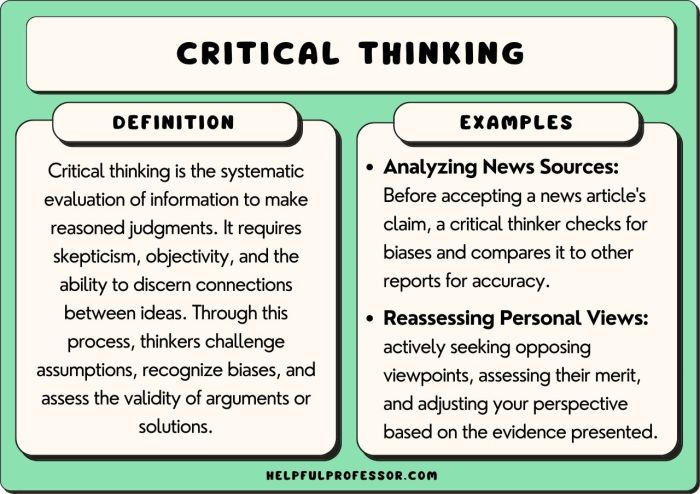
Effective questioning is a cornerstone of critical thinking. It allows us to move beyond accepting information at face value and instead actively engage with it, uncovering hidden assumptions, identifying logical fallacies, and ultimately forming more informed opinions. Mastering various questioning techniques significantly enhances our analytical abilities and helps us to construct stronger, more nuanced arguments.
Open-Ended and Closed-Ended Questions
Open-ended and closed-ended questions serve distinct purposes in critical analysis. Open-ended questions encourage detailed responses and exploration of a topic, while closed-ended questions elicit concise, specific answers. Understanding this difference is crucial for directing the flow of information and achieving specific analytical goals.
Open-ended questions typically begin with words like “how,” “why,” “what,” and “describe,” prompting more expansive answers. For example, “How did the economic policies of the 1980s contribute to the rise of income inequality?” is an open-ended question. In contrast, closed-ended questions often elicit a “yes” or “no” response or a choice from a limited set of options. For instance, “Did the government implement a tax cut in 1981?” is a closed-ended question. The strategic use of both question types ensures a comprehensive exploration of an issue.
Formulating Probing Questions to Uncover Underlying Assumptions
Probing questions are designed to delve beneath the surface of stated arguments, identifying implicit assumptions and biases that may be influencing the reasoning. These questions challenge the taken-for-granted aspects of an argument, pushing for greater clarity and justification. Effective probing questions often utilize words like “assume,” “presume,” “based on what,” and “what if.” For example, if someone argues that a particular policy is beneficial because it stimulates economic growth, a probing question might be, “What assumptions are you making about the distribution of benefits from this economic growth?” or “What if unforeseen consequences, such as increased inflation, arise from this policy?” Such questioning forces a more thorough examination of the argument’s foundations.
Challenging Arguments by Identifying Weaknesses in Logic
A critical thinker actively seeks weaknesses in any given argument. This involves formulating questions that directly target the logical structure of the argument, looking for inconsistencies, fallacies, or unsupported claims. Questions focusing on evidence, reasoning, and the overall coherence of the argument are particularly useful. For instance, if someone argues that a particular drug is effective because many people report feeling better after taking it, a challenging question could be, “Is there evidence that the reported improvements are causally linked to the drug, or could other factors be contributing to these feelings?” Another example: “Does the evidence presented adequately support the conclusion, or are there alternative explanations?” This systematic questioning helps to expose vulnerabilities in the argument’s structure.
Clarifying Ambiguous Statements Before Forming an Opinion
Ambiguous statements, characterized by vagueness or multiple interpretations, can hinder effective critical thinking. Before forming an opinion, it’s crucial to clarify any ambiguous aspects of an argument or statement. This involves asking questions that seek to define terms, specify context, and eliminate any potential misunderstandings. For example, if someone states that “the economy is improving,” clarifying questions might include, “What specific economic indicators are you using to measure improvement?” or “Compared to what period are you considering this improvement?” Such clarification ensures that any subsequent analysis is based on a shared understanding of the facts and avoids misinterpretations that could lead to flawed conclusions.
Practicing Analytical Skills
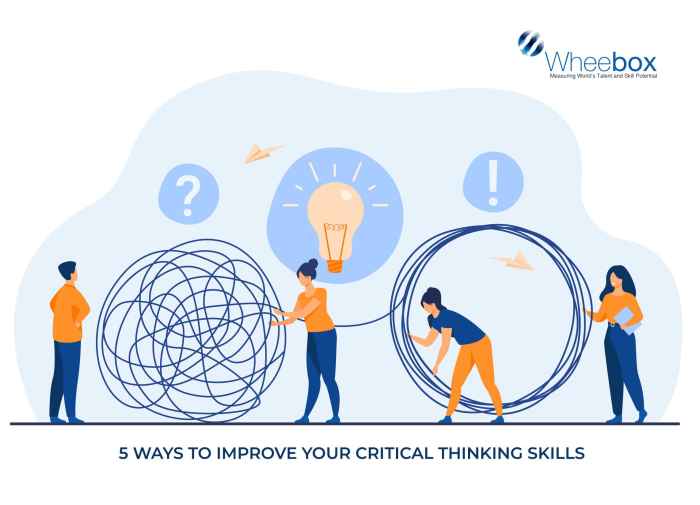
Developing strong analytical skills is crucial for effective critical thinking. It allows us to dissect complex information, identify underlying assumptions, and arrive at well-supported conclusions. This involves mastering techniques like problem decomposition, understanding reasoning types, and evaluating information credibility.
Breaking Down Complex Problems
Complex problems often appear overwhelming. The key to tackling them lies in breaking them down into smaller, more manageable parts. This process, often called decomposition, involves identifying the different components of the problem, analyzing their interrelationships, and then addressing each component systematically. For instance, consider the problem of improving a company’s declining sales. This can be broken down into analyzing market trends, evaluating the effectiveness of marketing campaigns, assessing product quality, examining customer satisfaction, and investigating internal operational efficiencies. By addressing each of these smaller issues individually, a more comprehensive and effective solution can be developed. Each sub-problem can then be further broken down if necessary, creating a hierarchical structure that simplifies the overall task.
Deductive and Inductive Reasoning
Deductive and inductive reasoning are two fundamental approaches to logical thinking. Deductive reasoning starts with general principles and moves towards specific conclusions. If the premises are true, the conclusion must also be true. For example: Premise 1: All men are mortal. Premise 2: Socrates is a man. Conclusion: Therefore, Socrates is mortal. Inductive reasoning, conversely, moves from specific observations to broader generalizations. The conclusion is likely, but not guaranteed, to be true. For example: Observation: Every swan I have ever seen is white. Conclusion: Therefore, all swans are white (this is false, as black swans exist). Understanding the differences between these approaches is crucial for evaluating the strength of arguments and avoiding logical fallacies.
Evaluating Source Credibility
Evaluating the credibility of information sources is paramount in critical thinking. A systematic approach is necessary to determine the reliability and trustworthiness of information. This involves considering several factors: The author’s expertise and potential biases, the publication’s reputation and editorial process, the evidence presented to support claims, the date of publication and potential for outdated information, and the presence of corroborating evidence from multiple sources. By carefully considering these aspects, we can better assess the validity of the information we encounter. For instance, a study published in a peer-reviewed scientific journal by a recognized expert in the field carries significantly more weight than an opinion piece on a blog with unknown authorship.
Methods for Evaluating Evidence
| Method | Description | Strengths | Weaknesses |
|---|---|---|---|
| Internal Consistency | Checking for contradictions within a single source. | Easy to apply; reveals internal flaws. | Doesn’t guarantee overall accuracy; ignores external context. |
| External Consistency | Comparing information across multiple sources. | Stronger evidence if multiple sources agree. | Requires access to multiple sources; can be time-consuming. |
| Source Bias Assessment | Identifying potential biases of the author or publication. | Helps to interpret information critically. | Requires understanding of potential biases; subjective interpretation. |
| Evidence Type Analysis | Evaluating the type of evidence presented (e.g., anecdotal, statistical, experimental). | Allows for assessment of evidence strength. | Requires understanding of different evidence types; can be complex. |
Epilogue

Developing strong critical thinking skills is an ongoing process, requiring consistent practice and self-reflection. By diligently applying the exercises Artikeld in this guide, you’ll cultivate a more discerning mind, better equipped to evaluate information, identify biases, and formulate well-reasoned conclusions. Embrace the challenge, and watch your analytical abilities flourish. The journey to sharper analysis starts with a commitment to self-improvement and the consistent application of these techniques.