Effective decision-making is a cornerstone of personal and professional success. Yet, many struggle with the process, often feeling overwhelmed by complexity or swayed by biases. This guide offers a practical approach, presenting three robust frameworks to navigate difficult choices and consistently make better decisions. We’ll explore different decision-making styles, analyze their strengths and weaknesses, and provide tools to enhance your decision-making process.
Through the lens of Cost-Benefit Analysis, the Decision Matrix, and the Pareto Principle (80/20 rule), we’ll equip you with the knowledge and techniques to approach choices strategically. This isn’t about finding the perfect solution every time, but rather about developing a systematic approach that increases the likelihood of making choices aligned with your goals and values. We’ll also address common cognitive biases that can cloud judgment and offer strategies to mitigate their influence.
Understanding Your Decision-Making Style

Effective decision-making isn’t just about choosing the right option; it’s about understanding the process you use to arrive at that option. Recognizing your personal decision-making style allows for greater self-awareness, leading to more confident and effective choices. Different styles have unique strengths and weaknesses, and understanding these nuances can significantly improve your outcomes.
Decision-Making Style Categories
Three common decision-making styles are Directive, Analytical, and Conceptual. Each style involves a different approach to information gathering, processing, and ultimately, decision-making. Understanding these styles can help you identify your dominant approach and pinpoint areas for improvement.
Directive Style: Strengths, Weaknesses, and Examples
Individuals with a directive style are efficient and decisive. They focus on facts and are comfortable with limited information. They value speed and efficiency above all else. Strengths include decisiveness, speed, and efficiency. Weaknesses can include overlooking important details, being insensitive to others’ feelings, and making impulsive decisions. For example, a manager using this style might quickly make a hiring decision based on a candidate’s resume alone, without conducting thorough interviews.
Analytical Style: Strengths, Weaknesses, and Examples
The analytical style is characterized by a thorough and systematic approach. These individuals prefer to gather as much information as possible before making a decision. They carefully consider all options and potential consequences. Strengths include accuracy, thoroughness, and consideration of multiple perspectives. Weaknesses can include being indecisive, slow, and potentially overwhelmed by too much information. For example, someone buying a car might spend weeks researching different models, reading reviews, and comparing specifications before making a purchase.
Conceptual Style: Strengths, Weaknesses, and Examples
Conceptual decision-makers are creative and innovative. They are comfortable with risk and value long-term perspectives. They often brainstorm multiple options and are open to new ideas. Strengths include creativity, long-term vision, and flexibility. Weaknesses can include being indecisive, lacking focus on details, and potentially ignoring practical considerations. For example, an entrepreneur launching a new product might focus on the innovative aspects and long-term market potential, while potentially overlooking immediate production challenges.
Recognizing Your Style and Improving Choices
Knowing your dominant decision-making style allows you to leverage its strengths and mitigate its weaknesses. For instance, if you’re primarily directive, consciously make an effort to seek more input from others and consider different perspectives before making important decisions. Conversely, if you tend to be analytical, focus on setting deadlines to avoid analysis paralysis and prioritize the most critical information. Understanding your style allows for more intentional and effective decision-making.
Questionnaire: Identifying Your Decision-Making Style
The following questionnaire helps you identify your dominant decision-making style. For each question, select the answer that best reflects your typical approach.
| Question | Directive | Analytical | Conceptual |
|---|---|---|---|
| When making a decision, I generally… | Focus on the most important facts and make a quick decision. | Gather as much information as possible before making a decision. | Consider multiple perspectives and brainstorm creative solutions. |
| I prefer to work with… | Clear goals and concise information. | Detailed data and analysis. | Open-ended discussions and brainstorming sessions. |
| My decision-making process is typically… | Fast and efficient. | Thorough and methodical. | Creative and innovative. |
| When faced with uncertainty, I tend to… | Make a decision based on limited information. | Seek more information to reduce uncertainty. | Embrace the uncertainty and explore multiple possibilities. |
Applying Three Frameworks for Better Choices

Making effective decisions is crucial for personal and professional success. While understanding your decision-making style is a vital first step, applying structured frameworks can significantly improve the quality and consistency of your choices. This section explores three powerful frameworks: Cost-Benefit Analysis, the Decision Matrix, and the Pareto Principle (80/20 rule), offering practical steps and real-world examples to help you make better choices.
Cost-Benefit Analysis
Cost-benefit analysis is a systematic approach to decision-making that weighs the potential gains (benefits) against the potential losses (costs) of a particular course of action. This framework helps to quantify the value of different options, enabling a more objective comparison.
- Identify all potential costs: This includes financial costs, time investment, opportunity costs (what you’re giving up by choosing this option), and potential risks or negative consequences.
- Identify all potential benefits: This includes financial gains, time savings, improved relationships, increased efficiency, and other positive outcomes.
- Quantify costs and benefits: Assign numerical values (monetary or otherwise) to each cost and benefit to allow for direct comparison. This may require estimations, but strive for reasonable accuracy.
- Compare total costs and benefits: Subtract the total costs from the total benefits. A positive result suggests the option is worthwhile; a negative result suggests it’s not.
- Consider intangible factors: While quantification is key, acknowledge qualitative aspects that are difficult to measure numerically, such as reputational impact or emotional well-being.
For example, consider the decision of whether to purchase a new car. The costs might include the purchase price, insurance, fuel, maintenance, and depreciation. The benefits might include convenience, safety, and a potential increase in social status. By assigning monetary values to each cost and benefit and comparing the totals, a clearer picture of the financial implications emerges, informing the decision.
Decision Matrix
The Decision Matrix is a valuable tool for evaluating multiple options against several criteria. This structured approach helps to organize complex information and compare options more effectively, reducing bias and promoting clarity. It is particularly useful when many factors influence the decision.
Let’s consider a company choosing a new software system. They identified three potential systems (A, B, C) and four key criteria: cost, functionality, ease of use, and integration with existing systems. Each criterion is assigned a weight reflecting its importance (e.g., functionality is weighted higher than cost). Each system is then scored on each criterion (e.g., on a scale of 1-5). The weighted scores are calculated, and the system with the highest total weighted score is selected.
| System | Cost (Weight: 0.2) | Functionality (Weight: 0.4) | Ease of Use (Weight: 0.3) | Integration (Weight: 0.1) | Total Weighted Score |
|---|---|---|---|---|---|
| A | 4 (0.8) | 5 (2.0) | 3 (0.9) | 2 (0.2) | 3.9 |
| B | 3 (0.6) | 4 (1.6) | 5 (1.5) | 4 (0.4) | 4.1 |
| C | 2 (0.4) | 3 (1.2) | 4 (1.2) | 5 (0.5) | 3.3 |
In this example, System B would be chosen as it has the highest total weighted score, demonstrating a systematic and objective approach to the decision.
Pareto Principle (80/20 Rule)
The Pareto Principle suggests that roughly 80% of effects come from 20% of causes. In decision-making, this means identifying the 20% of actions that will yield 80% of the desired results. Focusing on these high-impact actions can significantly improve efficiency and effectiveness.
- Identify key objectives: Clearly define what you want to achieve.
- Analyze current activities: Determine which actions are contributing most significantly to your objectives.
- Prioritize high-impact activities: Focus your energy and resources on the 20% of actions that yield 80% of the results.
- Delegate or eliminate low-impact activities: Outsource or stop engaging in tasks that contribute minimally to your goals.
- Regularly review and adjust: The 80/20 rule is not static; regularly assess which actions are providing the most significant impact and adjust your focus accordingly.
For instance, a salesperson might find that 80% of their sales come from 20% of their clients. By focusing their efforts on nurturing those key clients, they can maximize their sales potential.
Improving Decision-Making Processes

Effective decision-making isn’t simply about choosing between options; it’s about establishing a robust process that minimizes errors and maximizes positive outcomes. This involves understanding and mitigating cognitive biases, gathering and evaluating information strategically, and incorporating diverse perspectives to ensure a well-rounded approach. Finally, a strong decision-making process includes the creation of actionable plans and contingency strategies.
Improving your decision-making process requires a conscious effort to overcome inherent biases and build a structured approach. This involves actively seeking diverse viewpoints and planning for potential obstacles. By implementing these strategies, you can significantly enhance the quality and effectiveness of your choices.
Mitigating Cognitive Biases
Cognitive biases are systematic errors in thinking that can significantly impact our decisions. Recognizing and mitigating these biases is crucial for improved decision-making. For example, confirmation bias – the tendency to favor information confirming pre-existing beliefs – can lead to overlooking crucial data. Similarly, anchoring bias, where initial information disproportionately influences subsequent judgments, can skew the evaluation of options. To counter these, actively seek out contradictory information, challenge your assumptions, and consider diverse perspectives before making a decision. Consider using techniques like the “pre-mortem” – imagining a failed outcome and identifying potential causes – to proactively address potential blind spots.
Gathering and Evaluating Relevant Information
Effective information gathering involves a structured approach. Begin by clearly defining the decision problem and the desired outcome. Then, identify key information needs. This might involve researching industry reports, conducting surveys, interviewing stakeholders, or analyzing historical data. Once gathered, critically evaluate the information’s source, credibility, and potential biases. Utilize techniques like cost-benefit analysis or decision matrices to weigh different options against specific criteria. This structured approach helps avoid relying solely on intuition or readily available information, leading to more informed choices. For instance, in deciding on a new marketing campaign, a company should collect data on past campaigns, target audience preferences, and competitor strategies before selecting a specific approach.
Incorporating Diverse Perspectives
Diverse perspectives are invaluable in decision-making. They provide a broader range of insights, challenge assumptions, and help identify potential blind spots. Actively seek input from individuals with different backgrounds, experiences, and expertise. This might involve forming a decision-making team with a diverse membership or holding brainstorming sessions with a wide range of stakeholders. When incorporating diverse perspectives, it’s crucial to create a safe space for open communication and constructive feedback. This ensures that all voices are heard and considered without fear of judgment or reprisal. For example, a company deciding on a new product design should solicit feedback from potential users of diverse age groups, cultural backgrounds, and levels of technical expertise.
Formulating Actionable Plans and Contingency Planning
Once a decision is made, it’s crucial to translate it into a concrete action plan. This involves breaking down the decision into smaller, manageable steps with assigned responsibilities and deadlines. Furthermore, effective decision-making includes contingency planning – anticipating potential obstacles and developing alternative strategies to address them. For instance, a company launching a new product might develop contingency plans to address potential supply chain disruptions, negative customer reviews, or unexpected competitor actions. This proactive approach allows for adaptability and minimizes the impact of unforeseen circumstances. A clear, well-defined action plan with built-in flexibility ensures the chosen course of action is effectively implemented and adjusted as needed.
Summary
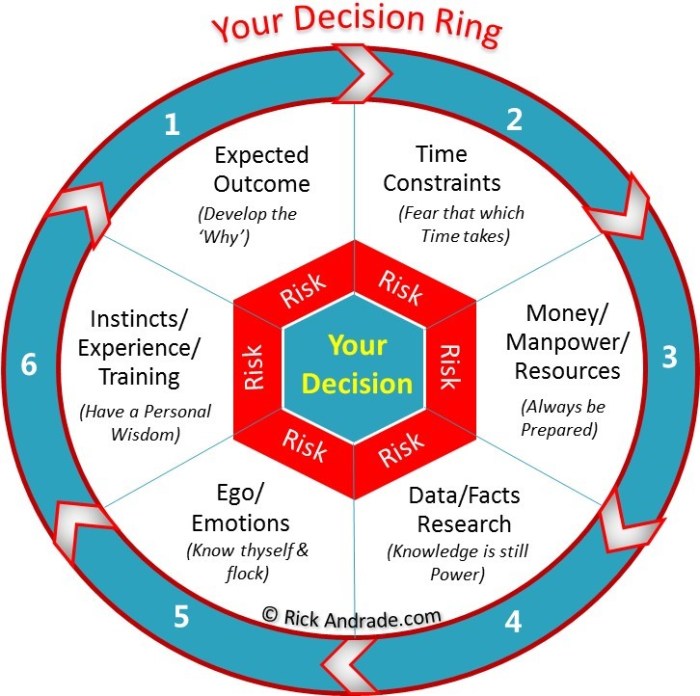
Mastering the art of decision-making is a continuous journey, not a destination. By understanding your personal style, leveraging powerful frameworks, and actively mitigating cognitive biases, you can significantly improve the quality of your choices. This guide provides a solid foundation for building a more decisive and effective approach to navigating life’s complexities. Remember, consistent application of these principles will lead to greater clarity, confidence, and ultimately, more successful outcomes. Start applying these frameworks today and experience the positive impact on your decision-making process.