Effective listening is more than just hearing; it’s about actively engaging with information and understanding its nuances. In today’s fast-paced world, honing your listening skills is crucial for success in both personal and professional spheres. This guide provides five straightforward yet powerful methods to transform your listening habits, leading to improved comprehension, stronger relationships, and increased productivity.
We’ll explore techniques ranging from minimizing distractions and improving focus to employing active listening strategies and enhancing memory retention. By mastering these methods, you’ll not only better understand what’s being communicated but also cultivate stronger connections with others and achieve a deeper level of comprehension.
Understanding Active Listening
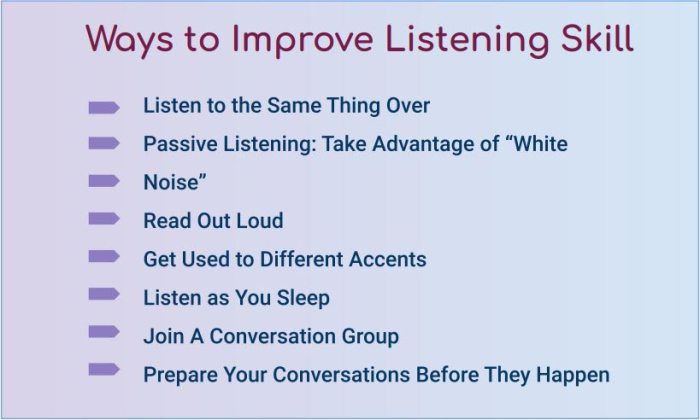
Active listening is far more than simply hearing words; it’s a dynamic process involving fully concentrating on the speaker, understanding their message, responding thoughtfully, and remembering what was said. Unlike passive listening, which involves minimal engagement and often results in missed information or misinterpretations, active listening requires conscious effort and engagement to truly grasp the speaker’s meaning. It fosters stronger relationships, improves communication clarity, and leads to more effective problem-solving.
Active listening differs from passive listening in its level of engagement and the intent behind the listening process. Passive listening is characterized by inattention, distraction, and a lack of genuine interest in the speaker’s message. Active listening, conversely, involves focused attention, empathy, and a conscious effort to understand both the verbal and nonverbal cues being communicated. The goal of active listening is to fully comprehend the speaker’s perspective, while passive listening often results in superficial understanding or complete misunderstanding.
Practical Examples of Active Listening Techniques
Active listening techniques significantly improve communication effectiveness. They demonstrate genuine interest and encourage open dialogue. Here are five practical examples:
- Summarizing: After the speaker finishes a point, briefly summarize their main ideas to confirm understanding. For example, “So, if I understand correctly, you’re saying that the project deadline is causing you significant stress.”
- Paraphrasing: Restate the speaker’s message in your own words to ensure accurate comprehension and show you’re following along. For instance, “It sounds like you’re feeling frustrated because of the lack of communication from the team.”
- Asking Clarifying Questions: Politely ask questions to clarify any ambiguous points. For example, “Could you elaborate on what you mean by ‘unforeseen circumstances’?”
- Reflecting Feelings: Acknowledge and validate the speaker’s emotions. For example, “It sounds like you’re feeling quite overwhelmed right now.”
- Empathetic Silence: Allow for pauses in the conversation to give the speaker time to process their thoughts and feel heard. This demonstrates respect and allows for deeper understanding.
Utilizing Nonverbal Cues to Enhance Active Listening
Nonverbal cues play a crucial role in active listening. They communicate engagement and understanding, building rapport and fostering trust. Maintaining eye contact shows attentiveness, while nodding indicates agreement and understanding. Leaning slightly towards the speaker demonstrates interest and encourages them to continue. Using open and relaxed body language conveys receptiveness. Mirroring subtle body language (but not in an exaggerated way) can build rapport. Avoiding distractions like checking your phone or interrupting showcases respect for the speaker. By consciously using these nonverbal cues, you create a supportive and encouraging environment for communication.
Role-Playing Scenario: Active vs. Passive Listening
Scenario: Two colleagues, Sarah and Mark, are discussing a project deadline.
Passive Listening (Mark): Sarah explains the challenges she’s facing meeting the deadline. Mark checks his email intermittently, sighs audibly, and offers only brief, dismissive responses like “Yeah,” or “Okay.” He doesn’t ask clarifying questions or offer support.
Active Listening (Mark): Sarah explains the challenges. Mark maintains eye contact, nods occasionally, and asks clarifying questions like, “Can you tell me more about the resource constraints you’re facing?” He paraphrases her concerns, saying things like, “So, it sounds like the unexpected delays with the supplier are significantly impacting your ability to complete the project on time.” He offers solutions and support.
Comparison of Active and Passive Listening Behaviors
| Behavior | Active Listening Example | Passive Listening Example | Impact on Communication |
|---|---|---|---|
| Attention | Maintains consistent eye contact, minimizes distractions. | Frequently glances away, checks phone, interrupts. | Focused vs. Distracted communication; enhanced vs. impaired understanding. |
| Response | Summarizes, paraphrases, asks clarifying questions. | Offers minimal verbal feedback, makes dismissive comments. | Encourages open dialogue vs. shuts down conversation; builds trust vs. creates distance. |
| Body Language | Open posture, leans in, nods to show understanding. | Closed posture, avoids eye contact, fidgets. | Conveys engagement and respect vs. shows disinterest and disrespect. |
| Emotional Response | Empathetically acknowledges and validates the speaker’s feelings. | Shows little or no emotional response, appears indifferent. | Creates a safe and supportive environment vs. creates an unwelcoming atmosphere. |
Minimizing Distractions and Enhancing Focus
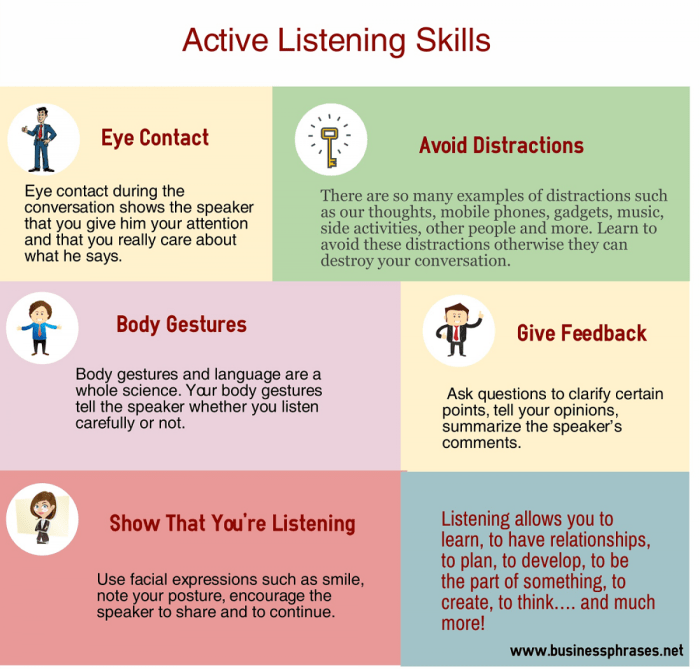
Effective listening requires a significant degree of concentration. Internal and external distractions can severely impede our ability to process information accurately and retain what we hear. By actively managing these distractions, we can significantly improve our listening comprehension and overall communication skills.
Distractions come in many forms, both internal and external. Internal distractions stem from our own minds and emotions, while external distractions originate from our environment. Effectively managing both is key to becoming a better listener.
Internal Distractions and Their Management
Internal distractions are often the most challenging to overcome. These include racing thoughts, worries about the future, rumination on the past, and strong emotional responses. To mitigate these, we can employ several strategies. Mindfulness practices, such as focusing on our breath or observing our thoughts without judgment, can help create mental space and reduce the impact of these intrusive thoughts and feelings. Techniques like meditation or even brief moments of deep breathing can significantly improve focus. Additionally, practicing self-compassion and acknowledging the presence of these thoughts without letting them derail our attention is crucial. For instance, if you find yourself worrying during a conversation, acknowledge the worry, gently redirect your attention back to the speaker, and remind yourself that you can address your concerns later.
External Distractions and Their Mitigation
External distractions, such as noisy environments, visual clutter, or interruptions, can significantly hinder our ability to listen effectively. Creating a quiet environment is paramount. This might involve finding a secluded space, asking others to keep the noise down, or utilizing noise-canceling headphones or earplugs. Minimizing visual distractions is equally important. Clearing your workspace of unnecessary items, turning off notifications on your devices, and focusing your gaze on the speaker can help maintain concentration. Consider the impact of a bustling coffee shop versus a quiet library; the difference in your ability to focus is immediately apparent.
A Step-by-Step Guide to Improving Concentration During Conversations
- Prepare Your Environment: Before the conversation begins, create a space that minimizes external distractions. This could involve finding a quiet room, turning off your phone, or putting away any distracting objects.
- Center Yourself: Take a few moments to calm your mind. Practice deep breathing or a brief mindfulness exercise to reduce internal distractions and improve your focus.
- Focus on the Speaker: Pay attention to the speaker’s words, tone, and body language. Avoid interrupting or formulating your response while they are still speaking.
- Engage Actively: Use nonverbal cues, such as nodding or making eye contact, to show you’re listening. Ask clarifying questions if needed, but avoid interrupting the flow of the conversation.
- Practice Active Recall: After the conversation, take a moment to summarize what you heard to yourself. This strengthens memory and comprehension.
The Impact of Mindfulness on Listening Focus
Mindfulness techniques, such as meditation and mindful breathing, directly address the root cause of many listening difficulties: a wandering mind. By cultivating present moment awareness, we train our minds to resist distractions and stay anchored in the here and now. Studies have shown that regular mindfulness practice can improve attention span, reduce stress, and enhance emotional regulation – all of which are crucial for effective listening. For example, a study published in the journal “Mindfulness” showed that participants who engaged in a mindfulness-based intervention exhibited significant improvements in their ability to focus on auditory stimuli.
Improving Comprehension and Retention

Effective listening isn’t just about hearing; it’s about understanding and remembering what you’ve heard. Improving comprehension and retention requires conscious effort and the application of specific strategies. By implementing these techniques, you can significantly enhance your ability to process and recall information from lectures, meetings, and conversations.
Effective Note-Taking Methods
Choosing the right note-taking method can dramatically impact comprehension. Different methods suit different learning styles and contexts. Experiment to find what works best for you.
- Linear Note-Taking: This traditional method involves writing notes in a sequential manner, often in sentence form. It’s straightforward and works well for lectures with a clear, linear progression of ideas. For example, during a history lecture, you might write down key dates, names, and events in chronological order.
- Cornell Note-Taking: This method divides your page into three sections: a main note-taking area, a cue column (for s and questions), and a summary section. The cue column allows for easy review and the summary forces you to synthesize the information. Imagine using this method for a science lecture; the main area would contain detailed notes, the cue column would have key terms and concepts, and the summary would concisely recap the lecture’s main points.
- Sketchnoting: This visual method combines drawings, symbols, and s to represent ideas. It’s particularly effective for remembering complex information and fostering creativity. For instance, during a marketing meeting, you could sketch a mind map with key concepts and use icons to represent different marketing strategies.
Summarizing Versus Paraphrasing
Both summarizing and paraphrasing are crucial for enhancing retention, but they serve different purposes.
Summarizing condenses large amounts of information into a concise overview, highlighting the main points. For example, summarizing a chapter from a textbook would involve identifying the central argument and key supporting details. Paraphrasing, on the other hand, rewords information in your own words while maintaining the original meaning. This active process strengthens understanding and helps to avoid plagiarism. Paraphrasing a complex scientific definition would involve re-expressing it in simpler terms without altering its core meaning.
Asking Clarifying Questions
Asking clarifying questions is vital for ensuring understanding. Well-formulated questions demonstrate engagement and allow you to address any ambiguities.
Examples of clarifying questions include: “Could you please elaborate on…?”, “Can you provide an example of…?”, “What do you mean by…?”, “I’m not sure I understand; could you explain that again?”. Asking such questions shows active participation and ensures you grasp the information fully.
Connecting New Information to Existing Knowledge
Connecting new information to what you already know is a powerful memory aid. This process, known as elaboration, creates meaningful associations, making the new information easier to remember.
For example, if you’re learning about a new historical event, you can relate it to similar events you already know, highlighting similarities and differences. This strengthens your understanding and improves retention.
Memory Aids for Retaining Information
Employing memory aids can significantly boost your ability to recall information from conversations.
- Repetition: Repeating key points aloud or silently reinforces memory.
- Mnemonics: Using acronyms, rhymes, or visual imagery to create memorable associations.
- Chunking: Breaking down large pieces of information into smaller, manageable chunks.
- Spaced Repetition: Reviewing information at increasing intervals to improve long-term retention.
- Association: Connecting new information to existing memories or personal experiences.
Closure
Ultimately, optimizing your listening skills is an investment in yourself and your future. By consciously implementing the strategies Artikeld—from actively engaging with speakers to minimizing distractions and enhancing your memory—you’ll unlock a world of improved communication, stronger relationships, and increased personal and professional success. The journey to becoming a more effective listener is ongoing, but with consistent effort and practice, the rewards are substantial and far-reaching.