Unlocking the secrets to a sharper, more efficient memory is within reach. This guide delves into the fascinating world of memory, exploring its different types and the biological processes that underpin its function. We’ll then equip you with five practical, easy-to-implement techniques to significantly improve your memory recall and retention. Prepare to enhance your cognitive abilities and experience the benefits of a boosted memory.
By understanding how short-term, long-term, and working memory operate, you can strategically approach learning and information processing. We’ll examine the impact of lifestyle choices – including sleep, diet, and exercise – on memory performance, and offer actionable steps to cultivate a memory-boosting lifestyle. This isn’t just about memorizing facts; it’s about building a stronger, more resilient cognitive foundation.
Understanding Memory & Its Types
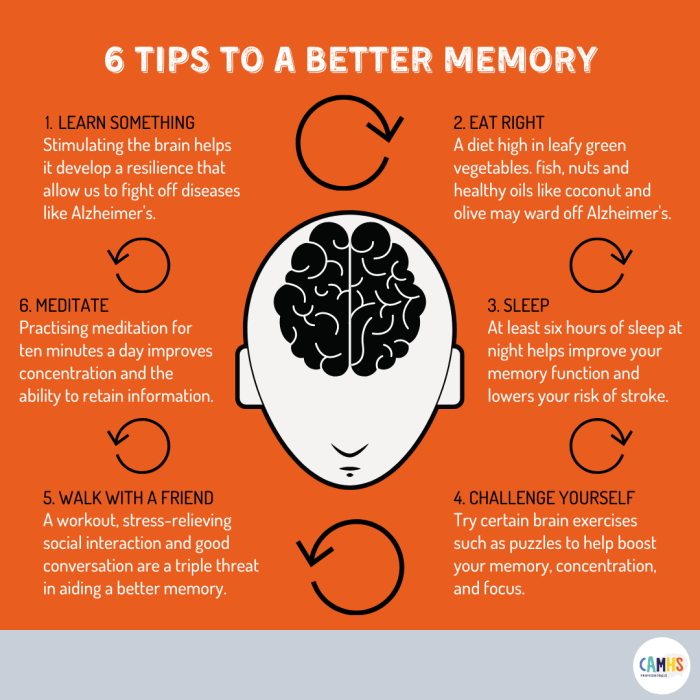
Memory is a complex cognitive process crucial for learning, remembering, and adapting to our environment. It’s not a single entity but rather a system comprised of different interacting components, each with its own characteristics and functions. Understanding these different types of memory is key to optimizing your memory capabilities.
Our memory system can be broadly categorized into three main types: sensory memory, short-term memory (STM), and long-term memory (LTM). While sensory memory acts as a fleeting initial stage, short-term memory holds information temporarily, and long-term memory stores information for extended periods. Within long-term memory, further distinctions exist, such as episodic memory (personal events), semantic memory (facts and general knowledge), and procedural memory (skills and habits). Working memory, often considered a part of short-term memory, is particularly important for cognitive tasks requiring manipulation of information.
Short-Term Memory
Short-term memory (STM) is a temporary storage system with limited capacity. It holds information for a brief period, typically around 20-30 seconds, unless actively rehearsed. Think of it as a mental scratchpad. Examples of activities utilizing STM include remembering a phone number long enough to dial it, recalling a short list of items to buy from a grocery store, or mentally holding a sentence in mind while you try to understand its meaning. The biological basis of STM involves temporary changes in the strength of neuronal connections, primarily through sustained firing of neurons.
Long-Term Memory
Long-term memory (LTM) is a relatively permanent storage system with a vast capacity. Information is encoded and stored for extended periods, sometimes a lifetime. This involves the strengthening of synaptic connections between neurons through a process called long-term potentiation (LTP). Consolidation, the process of transferring information from STM to LTM, is crucial. Examples of LTM include remembering your childhood, knowing the capital of France, or remembering how to ride a bicycle. The specific brain regions involved in LTM vary depending on the type of memory; for instance, the hippocampus plays a critical role in forming new episodic memories.
Working Memory
Working memory is a cognitive system responsible for temporarily holding and manipulating information necessary for complex tasks such as reasoning, learning, and comprehension. It’s not simply a passive storage system like STM; it actively processes information. It’s crucial for tasks like mental arithmetic, problem-solving, and following complex instructions. For example, when solving a math problem, working memory holds the intermediate steps and results while performing calculations. The prefrontal cortex is heavily involved in working memory processes. Neurotransmitters like dopamine and glutamate also play a significant role in the efficiency of working memory.
Comparison of Memory Types
| Memory Type | Capacity | Duration | Example |
|---|---|---|---|
| Sensory Memory | Very large | Very short (milliseconds to seconds) | Briefly registering the image of a passing car |
| Short-Term Memory | Limited (7 ± 2 items) | Short (20-30 seconds) | Remembering a phone number long enough to dial it |
| Long-Term Memory | Essentially unlimited | Long (days, weeks, years, lifetime) | Remembering your childhood |
| Working Memory | Limited | Variable, depending on task | Solving a math problem in your head |
Practical Techniques for Memory Improvement

Improving your memory isn’t about possessing a naturally gifted brain; it’s about employing effective strategies. These techniques, when practiced consistently, can significantly enhance your ability to retain information and recall details. The key is regular practice and finding methods that best suit your learning style.
- Mnemonic Devices
Mnemonic devices are memory aids that use imagery, acronyms, or other techniques to associate information with something easily remembered. For example, the acronym ROY G. BIV helps remember the colors of the rainbow (Red, Orange, Yellow, Green, Blue, Indigo, Violet). By creating vivid mental images or using rhymes, you can link new information to existing knowledge, making it easier to retrieve. Consistent use strengthens this association. However, overly complex mnemonics can become counterproductive, and relying solely on mnemonics without understanding the underlying concepts may hinder deeper learning.
Mnemonic Device Application
Creating effective mnemonics requires creativity and practice. Let’s say you need to remember a grocery list: milk, eggs, bread, cheese, and apples. You could imagine a cow (milk) laying eggs on a loaf of bread, with a slice of cheese on top, and an apple perched on the side. The more bizarre and memorable the image, the better. The drawback is that creating elaborate images takes time and effort, and they might not be suitable for all types of information.
- Chunking
Chunking involves grouping individual pieces of information into larger, more manageable units. Instead of trying to memorize a long phone number digit by digit, you might break it into smaller chunks (e.g., 555-123-4567). This reduces the cognitive load and makes it easier to remember. The effectiveness of chunking depends on the size and organization of the chunks. Overly large chunks can become as difficult to remember as a long string of individual items.
Chunking Strategies
When studying a large amount of text, try breaking it into smaller paragraphs or sections. Each section can then be summarized into a key sentence or phrase, creating a manageable Artikel. Similarly, when learning a new language, grouping vocabulary words by theme (e.g., food, transportation) improves retention. The drawback is that if chunks are poorly organized or illogical, it can hinder recall.
- Spaced Repetition
Spaced repetition is a learning technique where you review information at increasing intervals. This combats the forgetting curve, which shows that we tend to forget information quickly unless we review it. By revisiting material at strategic intervals, you reinforce your memory and improve long-term retention. The optimal spacing intervals vary depending on the individual and the material, but generally involve reviewing material shortly after learning it, then again after a longer period, and so on. The drawback is that it requires a planned approach and consistent effort. Failing to adhere to the schedule can negate its benefits.
Spaced Repetition Scheduling
A simple spaced repetition schedule might involve reviewing material once after an hour, then again after a day, then after a week, and finally after a month. Apps and software are available to help automate this process. However, without a structured schedule and discipline, this method can easily be abandoned.
- Active Recall
Active recall involves actively retrieving information from memory without looking at your notes or other aids. This forces your brain to work harder and strengthens memory traces. Techniques like flashcards or self-testing are excellent ways to practice active recall. The more you actively retrieve information, the stronger the memory becomes. However, it can be challenging initially, and frustration may arise if you are unable to recall information immediately.
Active Recall Exercises
Instead of passively rereading notes, try summarizing the key concepts from memory. Then, compare your summary to the original material to identify any gaps in your understanding. Regularly quizzing yourself using flashcards or practice questions is also highly beneficial. The drawback is that it can be time-consuming and require significant self-discipline.
- Elaborative Rehearsal
Elaborative rehearsal involves connecting new information to existing knowledge and experiences. Instead of simply repeating information, you actively process it by making associations, creating examples, or generating explanations. This deeper processing strengthens memory significantly. The more meaningful the connections, the better the retention. However, this method can be time-consuming and requires a good understanding of the material.
Elaborative Rehearsal Example
If you are learning about the concept of photosynthesis, instead of just memorizing the definition, you could connect it to your knowledge of plants, sunlight, and the process of food production. You might also think about examples of plants that perform photosynthesis differently. The drawback is that it’s not as effective for rote memorization of facts.
Weekly Schedule for Memory Enhancement
| Day | Technique | Time Allotment | Notes |
|———-|————————–|—————–|———————————————|
| Monday | Mnemonic Devices | 15 minutes | Create mnemonics for grocery list/tasks |
| Tuesday | Chunking | 20 minutes | Organize notes/study material into chunks |
| Wednesday| Spaced Repetition | 30 minutes | Review previously learned material |
| Thursday | Active Recall | 25 minutes | Use flashcards or self-testing |
| Friday | Elaborative Rehearsal | 20 minutes | Connect new information to existing knowledge |
| Weekend | Review all techniques | 30 minutes | Reinforce learning, adjust schedule as needed |
Lifestyle Factors Influencing Memory

Maintaining optimal memory function isn’t solely about employing specific memorization techniques; it’s significantly influenced by our daily lifestyle choices. A holistic approach, encompassing diet, exercise, sleep, and stress management, is crucial for cultivating a sharp and resilient memory. Neglecting these aspects can lead to cognitive decline, while prioritizing them can significantly enhance memory performance.
The Impact of Nutrition on Memory Function
Nutrition plays a pivotal role in brain health and memory. A balanced diet rich in specific nutrients can fuel cognitive function, while poor dietary habits can impair it. For instance, a diet lacking in essential fatty acids, antioxidants, and B vitamins can negatively impact memory formation and retrieval. Conversely, incorporating brain-boosting foods can enhance cognitive performance. Examples include fatty fish (like salmon and tuna), rich in omega-3 fatty acids; blueberries, packed with antioxidants; and leafy green vegetables, providing essential vitamins and minerals. Regular consumption of these foods contributes to improved memory and overall cognitive health.
The Influence of Physical Activity on Cognitive Function
Regular physical activity is not just beneficial for physical health; it’s also a powerful tool for enhancing cognitive function and memory. Exercise increases blood flow to the brain, delivering oxygen and nutrients essential for optimal brain function. This improved circulation supports the growth of new brain cells and strengthens existing neural connections, leading to enhanced memory consolidation and retrieval. Studies have shown that individuals who engage in regular exercise demonstrate improved performance on memory tasks compared to their sedentary counterparts. Activities such as brisk walking, swimming, or cycling are effective ways to boost cognitive function.
The Relationship Between Sleep Quality and Memory Consolidation
Sleep is critical for memory consolidation – the process by which short-term memories are transformed into long-term memories. Imagine a graph depicting two lines: one representing memory performance after a night of restful sleep, and the other representing memory performance after a night of poor sleep. The line representing restful sleep would show a significantly higher level of memory retention and recall, demonstrating a steep upward trend. In contrast, the line illustrating poor sleep would show a much lower level of memory retention, with a flatter, less inclined line. This visual representation underscores how crucial sleep is for transferring information from short-term to long-term memory. Insufficient or poor-quality sleep disrupts this process, leading to impaired memory and reduced cognitive performance.
Final Conclusion

Improving your memory is a journey, not a destination. By consistently applying the five techniques Artikeld and incorporating the suggested lifestyle changes, you can expect to see a noticeable improvement in your memory capacity and recall. Remember that consistency is key, and even small, incremental changes can yield significant long-term benefits. Embrace the process, celebrate your progress, and enjoy the rewards of a sharper, more reliable memory.