Negotiation is a fundamental skill applicable across various life aspects, from securing a better salary to closing a significant business deal. This guide delves into five key strategies to elevate your negotiation prowess, transforming you from a passive participant into an assertive and successful negotiator. We’ll explore preparation, communication, tactical approaches, and concession management, equipping you with the tools to achieve favorable outcomes while fostering positive relationships.
Through practical examples, actionable steps, and insightful analysis, you will learn to anticipate your counterpart’s needs, communicate effectively, and strategically manage concessions to achieve your desired results. This guide provides a structured approach to negotiation, making it accessible and applicable regardless of your experience level. Whether you’re a seasoned professional or just starting out, these strategies will significantly enhance your negotiation capabilities.
Preparation & Planning
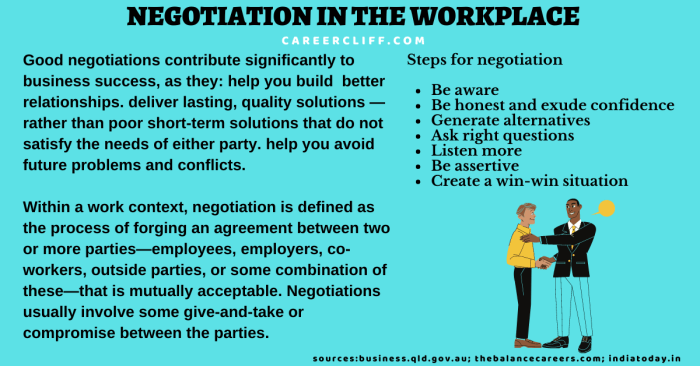
Effective negotiation hinges on meticulous preparation and strategic planning. Thorough groundwork significantly increases your chances of achieving favorable outcomes and minimizes the risk of costly mistakes. This section delves into the essential elements of pre-negotiation preparation, offering practical strategies for maximizing your success.
Key Elements of Pre-Negotiation Preparation
Thorough preparation involves researching the other party, defining your goals, and anticipating potential challenges. Research should encompass their background, past negotiations, financial standing, and current circumstances. Clearly defining your goals, including your ideal outcome and your walk-away point, provides a crucial framework for your negotiation strategy. Anticipating potential obstacles allows you to develop contingency plans and maintain a flexible approach throughout the process.
Strategies for Identifying the Other Party’s Needs and Priorities
Understanding the other party’s needs and priorities is paramount to successful negotiation. Five effective strategies for achieving this understanding include:
- Direct Inquiry: Politely and strategically asking questions about their needs and expectations can provide valuable insights. For example, “What are your primary concerns regarding this deal?”
- Background Research: Investigating their company’s public statements, press releases, and financial reports can reveal their strategic objectives and priorities.
- Industry Analysis: Understanding industry trends and competitive pressures can help you infer their needs and potential motivations.
- Networking and Information Gathering: Leveraging your network to gather information about the other party’s reputation and past dealings can provide valuable context.
- Observational Analysis: Paying close attention to their communication style and body language during preliminary interactions can reveal subtle clues about their priorities.
Creating a Range of Potential Outcomes and Developing a Walk-Away Point
Establishing a range of potential outcomes and a clear walk-away point is crucial for maintaining control and avoiding impulsive decisions. This involves considering various scenarios and assigning probabilities to each. Your walk-away point serves as your bottom line – the point beyond which you are unwilling to negotiate.
| Potential Outcome | Probability | Your Ideal | Your Walk-Away Point |
|---|---|---|---|
| Full price acceptance | 20% | $100,000 | $90,000 |
| Negotiated price (95%) | 60% | $100,000 | $90,000 |
| Negotiated price (90%) | 15% | $100,000 | $85,000 |
| Deal falls through | 5% | $100,000 | $85,000 |
Negotiation Styles and Adapting Your Approach
Different individuals and organizations employ varying negotiation styles. Some common styles include:
- Competitive: These negotiators prioritize winning and may employ aggressive tactics.
- Collaborative: These negotiators seek mutually beneficial outcomes and emphasize building relationships.
- Accommodating: These negotiators prioritize maintaining relationships over achieving optimal outcomes.
- Avoiding: These negotiators prefer to avoid conflict and may postpone or withdraw from negotiations.
- Compromising: These negotiators seek a middle ground, willing to concede some points to reach an agreement.
Adapting your approach requires recognizing the other party’s style and adjusting your tactics accordingly. For example, against a competitive negotiator, a collaborative approach might be ineffective, requiring a more assertive strategy. Conversely, a highly collaborative approach would be well-suited to a similarly collaborative opponent. Flexibility and adaptability are key to success in any negotiation.
Effective Communication & Active Listening

Effective communication and active listening are cornerstones of successful negotiation. Building rapport and fostering mutual understanding are crucial for reaching mutually beneficial agreements. Without these skills, even the most meticulously planned negotiation can falter. This section explores techniques to enhance communication and listening skills within a negotiation context.
Active Listening Techniques
Active listening goes beyond simply hearing words; it involves fully understanding the speaker’s perspective. Employing these techniques demonstrably improves communication and strengthens relationships during negotiation.
- Pay Attention: Minimize distractions and focus entirely on the speaker. Observe their body language and tone of voice as well as their spoken words.
- Show You’re Listening: Use verbal cues like “I understand,” “Tell me more,” or “That’s interesting” to signal engagement. Maintain appropriate eye contact, nod occasionally, and mirror their body language subtly to show empathy.
- Provide Feedback: Summarize or paraphrase what you’ve heard to confirm your understanding. For example, “So, if I understand correctly, your main concern is…” This clarifies any misunderstandings and ensures both parties are on the same page.
- Defer Judgment: Avoid interrupting or formulating your response while the other person is speaking. Listen objectively, even if you disagree with their points. Restraining immediate counterarguments allows for a deeper understanding of their position.
- Ask Clarifying Questions: Don’t hesitate to ask questions to gain a clearer understanding. Phrases like “Can you elaborate on that?” or “What do you mean by…?” can significantly enhance comprehension and prevent assumptions.
Clear and Concise Communication
Clear communication minimizes misunderstandings and ensures everyone is working with the same information. Using precise language and avoiding jargon is essential.
Effective phrasing involves stating your needs and desires directly but respectfully. Instead of saying “I think we should…”, try “I propose we…” or “My suggestion is…”. Instead of demanding “You must…”, consider “It would be beneficial if…” or “I would appreciate it if…”. These subtle shifts in phrasing can significantly impact the negotiation’s tone and outcome. For instance, instead of saying “Your price is too high,” a more constructive approach might be “While I appreciate your offer, our budget allows for a slightly lower price point.”
Nonverbal Communication’s Impact
Nonverbal cues, such as body language, facial expressions, and tone of voice, significantly influence negotiation outcomes. They can convey confidence, trustworthiness, or conversely, anxiety and distrust.
Managing body language involves maintaining open and inviting posture, making appropriate eye contact, and using hand gestures sparingly. Avoiding crossed arms or legs, fidgeting, or other distracting behaviors demonstrates confidence and attentiveness. A calm and controlled tone of voice also contributes to a more positive negotiation environment. Mirroring the other party’s positive body language (while remaining genuine) can subtly build rapport and trust.
Successful Negotiation Scenario
- The Situation: Two companies, A and B, are negotiating a joint venture. Company A wants a 60/40 profit split, while Company B prefers 50/50.
- Active Listening: Company A’s negotiator actively listens to Company B’s concerns about equity, summarizing their points and asking clarifying questions about their desired profit share.
- Clear Communication: Company A’s negotiator explains their rationale for the 60/40 split, focusing on their greater investment and projected contribution to the venture’s success. They present data and projections clearly and concisely.
- Nonverbal Communication: Both negotiators maintain open postures, make appropriate eye contact, and speak in calm, respectful tones. They use gestures sparingly, avoiding any displays of aggression or defensiveness.
- Successful Outcome: Through active listening and clear communication, both parties find common ground. They agree on a 55/45 split, acknowledging the value of both companies’ contributions. The successful negotiation relies heavily on mutual respect and a collaborative spirit fostered through effective communication.
Strategic Tactics & Concession Management

Effective negotiation isn’t just about presenting your case; it’s about strategically maneuvering to achieve the best possible outcome. This involves understanding various tactics, anticipating potential pitfalls, and skillfully managing concessions to secure a favorable deal while preserving the relationship. This section delves into the art of strategic negotiation tactics and concession management.
Comparison of Negotiation Tactics
Negotiation tactics can significantly influence the outcome. Anchoring, brainstorming, and logrolling are three common approaches, each with its strengths and weaknesses. Anchoring involves setting an initial price or condition to influence subsequent discussions. Brainstorming fosters creative problem-solving by generating multiple options. Logrolling, or quid pro quo, involves trading concessions on less important issues to gain ground on more critical ones. While anchoring can be effective in setting the negotiation frame, it risks alienating the other party if perceived as unreasonable. Brainstorming encourages collaboration but may lead to unrealistic proposals. Logrolling can be highly effective in creating win-win scenarios but requires careful identification of issues of varying importance to both parties. A successful negotiator understands when and how to employ each tactic effectively.
Common Negotiation Pitfalls and Avoidance Strategies
Three common negotiation pitfalls are failing to prepare adequately, focusing solely on your own position, and neglecting relationship building. Insufficient preparation leads to missed opportunities and weaker positions. A myopic focus on one’s own interests can lead to stalemates and damaged relationships. Ignoring relationship building can hinder trust and collaboration, ultimately affecting the outcome. Avoiding these pitfalls requires thorough preparation, active listening to understand the other party’s perspective, and building rapport throughout the negotiation process. This might involve researching the other party’s needs and priorities, creating a flexible negotiation strategy that allows for adaptation, and actively seeking common ground.
Strategic Concession Management
Strategic concession management is crucial for maximizing gains while maintaining positive relationships. It involves making concessions selectively and strategically, not giving away too much too soon. Concessions should be justified, demonstrating value and building trust. They should also be linked to reciprocal concessions from the other party, creating a sense of fairness and collaboration. A well-structured concession strategy ensures that you receive adequate value in return for every concession made. Blindly giving concessions without reciprocity can lead to a weaker negotiation position and a sense of being taken advantage of.
Structuring a Concession Strategy
A structured approach to concession management is essential. The following table provides a framework for planning your concessions strategically:
| Concession | Justification | Expected Return |
|---|---|---|
| Reduce price by 5% | To demonstrate goodwill and expedite the closing process. | Faster deal closure, improved relationship. |
| Extend delivery date by one week | To accommodate the buyer’s current production schedule. | Secure the deal despite logistical challenges. |
| Offer complimentary training | To enhance the buyer’s experience and reduce implementation risks. | Increased customer satisfaction and potential future business. |
Ultimate Conclusion

By mastering preparation, honing communication skills, and employing strategic tactics, you can significantly improve your negotiation outcomes. Remember, successful negotiation is not about winning at all costs; it’s about achieving mutually beneficial agreements while building strong, lasting relationships. The strategies Artikeld in this guide provide a framework for navigating complex negotiations with confidence and achieving your goals. Practice these techniques, adapt them to your specific situations, and watch your negotiation skills flourish.